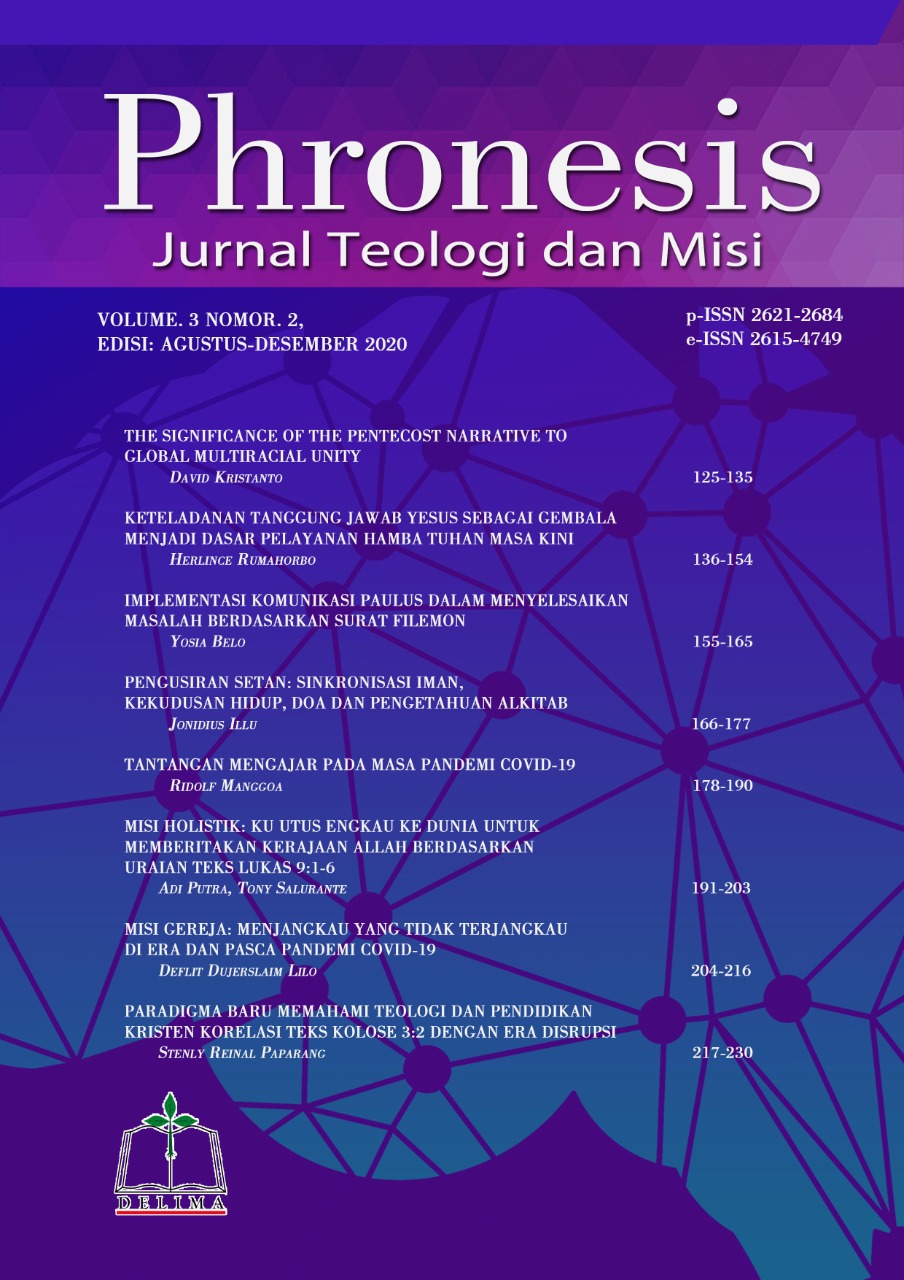
PARADIGMA BARU MEMAHAMI TEOLOGI DAN PENDIDIKAN KRISTEN KORELASI TEKS KOLOSE 3:2 DENGAN ERA DISRUPSI
DOI:
https://doi.org/10.47457/phr.v3i2.117Keywords:
paradigm, Theology and Christian education, correlation, disruption eraAbstract
The fact that the era of disruption creates many changes and shifts in various fields, urges certain parties in the educational environment to quickly adapt and even create breakthroughs in maintaining the substance of Christian theology and education through online application-based media. Changes in the learning process from face-to-face to online result in a variety of benefits as well as prudence. On the one hand online learning is not limited to space and time, and on the other hand forces certain parties to meet the demands of such learning. In the church environment also experienced the same thing. The process of personalization became online. Thus, the paradigm shift in Christian theology and education is an inescapable fact. Efforts to think of spiritual matters become a continuing responsibility, no matter what the situation. Disruption era shows the rise of online-based social media. Nevertheless, believers are encouraged to use it as a place to preach the gospel of Jesus Christ as a confirmation of the attitude of believers who think about the above. This article uses a library study method with an exegetic-correlational approach that explains the meaning of text in the frame of correlation with disruption era.
Downloads
Downloads
Published
Issue
Section
License
Authors who publish in Phronesis: Jurnal Teologi dan Misi agree to the following terms:
1. The author holds the copyright and grants to the journal the right of first publication of the work simultaneously licensed under a Creative Commons Attribution-ShareAlike 4.0 License, which allows others to share the work with an acknowledgment of the work's authorship and initial publication in this journal.
2. Authors may make additional separate contractual arrangements for the non-exclusive distribution of the published journal version of the work (for example, posting it to an institutional repository or publishing it in a book) with acknowledgment of its initial publication in this journal.
3. Authors are permitted and encouraged to post their work online (for example, in institutional repositories or on their websites) before and during the submission process, as this can result in a productive exchange, as well as earlier and larger citations of the published work (See Effects of Access Open).