
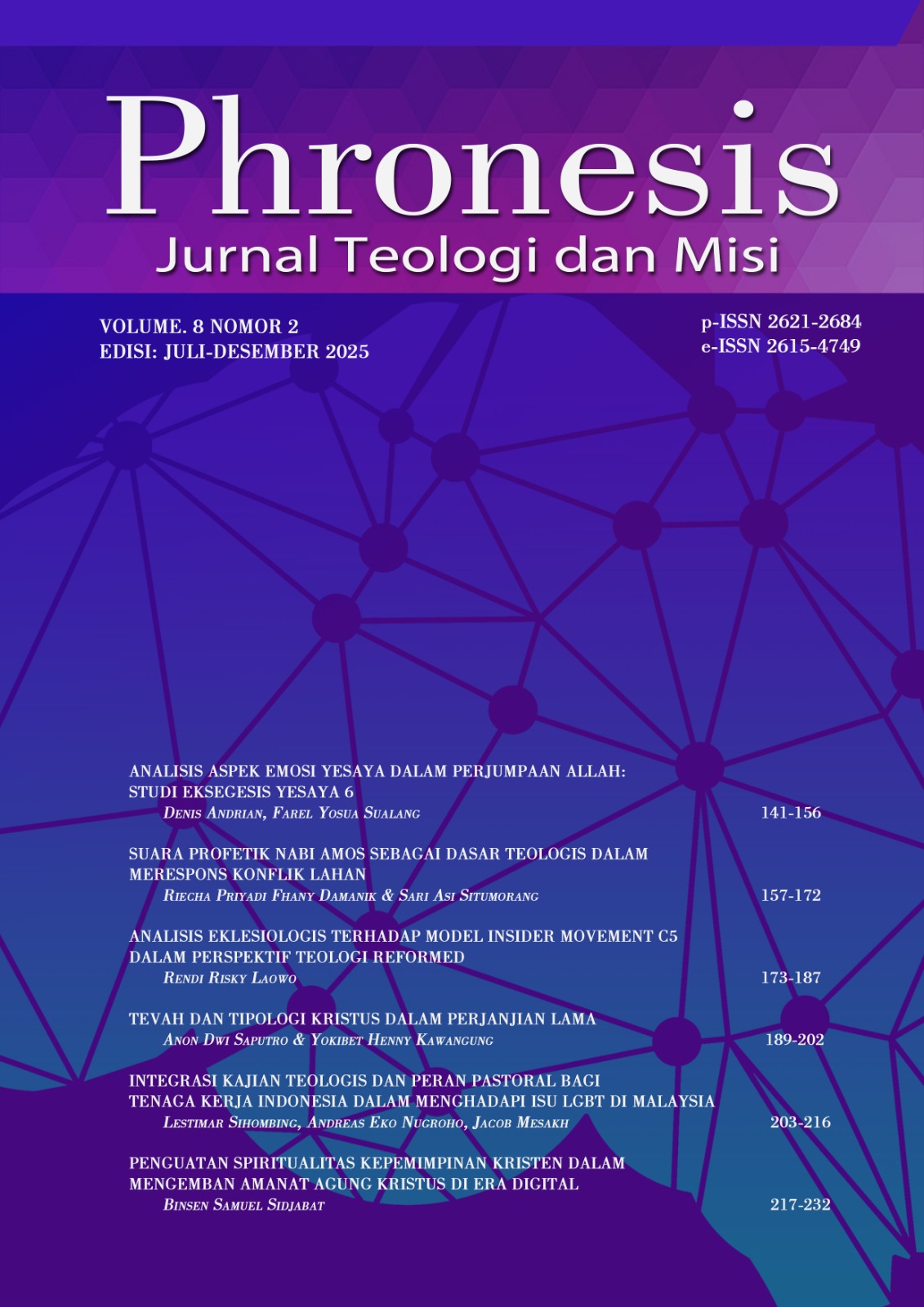
Analisis Aspek Emosi Yesaya dalam Perjumpaan Allah: Studi Eksegesis Yesaya 6
DOI:
https://doi.org/10.47457/phr.v8i2.591Keywords:
aspect of emotions, Biblical sound, divine encounter, exegesis, IsaiahAbstract
This article examines the aspect of emotions experienced by the prophet Isaiah in his encounter with God, described in Isaiah 6:1-8. This research is motivated by the lack of in-depth analysis of Isaiah's emotional aspects in the narrative, particularly using the 'Voice of the Bible' approach. Jill Middlemas, examines the emotional aspects of Isaiah's prophetic calling, but has not specifically highlighted the dynamics of Isaiah's emotional transition in encountering God. The research methodology involved textual analysis using an exegetical approach to Isaiah 6:1-8, including the study of key Hebrew words related to voice and emotion. Narrative analysis was used to identify the stages of the narrative and the emotions associated with each stage. In addition, a brief comparative analysis with call narratives from other prophets was conducted to provide a broader context. This research utilizes an interdisciplinary approach, combining perspectives from biblical studies, psychology, and spirituality. The significance of this research lies in its contribution to a deeper understanding of spiritual experience and its implications for contemporary spiritual life. By analyzing Isaiah's aspect of emotions, this research aims to provide new insights into the dynamics of divine encounter and spiritual transformation that can be applied in a modern context.
Downloads
References
Abraham J. Heschel. (1962). The Prophets. Harper & Row.
Andrew T. Abernethy. (2017). God’s Kingship in Isaiah 6 and 7:1-17: A Comparison. Bulletin for Biblical Research, 27(4), 295–313.
Boda, M. J. (2016). The book of Isaiah: Composition, reception, and interpretation. Brill.
Brevard S. Childs. (2001). Isaiah: A Commentary, Old Testament Library. Westminster John Knox Press.
Carol A. Newsom. (2003). The Book of Job: A Contest of Moral Imaginations. Oxford University Press.
Ganzel, T. & H. S. E. (2020). (2020). Divine fear and human response in Isaiah 6. Journal of Biblical Literature, 139(2), 235–254.
Gene M. Tucker. (2001). The Book of Isaiah 1-39. In New Interpreter’s Bible. Abingdon Press.
Hans Wildberger. (1991). Isaiah 1-12: A Commentary, Continental Commentary. Fortress Press.
J. Maxwell Miller, & John H. Hayes. (2006). A History of Ancient Israel and Judah. Westminster John Knox Press.
Jill Middlemas. (2021). The Divine Voice in Isaiah’s Memoirs. In George J. Brooke and Hindy Najman (Ed.), Prophets and Prophecy in Ancient Israelite Historiography (pp. 87–106). Eisenbrauns.
John Bright. (2000). A History of Israel. Westminster John Knox Press.
John D. Watts. (1985). Isaiah 1-33. In Word Biblical Commentary. Word Books.
John N. Oswalt. (1986). The Book of Isaiah Chapters 1-39. In NICOT. Eerdmans.
John N. Oswalt. (1999). Called to Be Holy: A Biblical Perspective. Asbury Theological Journal, 54, 27–41.
Katheryn Pfisterer Darr. (1994). Isaiah’s Vision and the Family of God. In Catholic Biblical Quarterly Monograph Series (Vol. 27). Catholic Biblical Association.
King, Philip J., & Lawrence E. Stager. (2001). Life in Biblical Israel. Westminster John Knox Press.
Lim, B. H. (2021). The Transformative Theology of Isaiah 6. Fortress Press.
Marjo C. A. Korpel, & Johannes C. de Moor. (2011). The Silent God. Brill.
Marvin A. Sweeney. (1996). Isaiah 1-39 with an Introduction to Prophetic Literature. Eerdmans.
Matthew Elliott. (2006). Faithful Feelings: Rethinking Emotion in the New Testament. Kregel Academic.
Mordechai Cogan. (2008). The Raging Torrent: Historical Inscriptions from Assyria and Babylonia Relating to Ancient Israel. Carta.
Moughtin-Mumby, S. (2018). From Terror to Mission: A Cognitive Linguistic Approach to Isaiah’s Call Narrative. Old Testament Essays, 31(3), 567–589.
Otto Kaiser. (1983). Isaiah 1-12: A Commentary (2nd ed.). Westminster Press.
Paul A. Kruger. (2004). On Emotions and the Expression of Emotions in the Old Testament: A Few Introductory Remarks. Biblische Zeitschrift , 48(2), 213–227.
Paul A. Kruger. (2005). The Face and Emotions in the Hebrew Bible. Old Testament Essays 18(3), 651–663.
Philip J. King. (2005). Emotions in the Biblical World: Cultural and Social Perspectives. Harvard Theological Review, 98(1), 1–21.
Philipp Sumpter. (2015). The Substance of Psalm 24: An Attempt to Read Scripture after Brevard S. Childs. Bloomsbury T&T Clark.
Rainer Albertz. (1994). A History of Israelite Religion in the Old Testament Period. Westminster John Knox Press.
R.E. Clements. (1980). Isaiah 1-39” New Century Bible Commentary. Eerdmans.
Robert Alter. (2011). The Art of Biblical Narrative. Basic Books.
Saul M. Olyan. (2004). Biblical Mourning: Ritual and Social Dimensions. Oxford University Press.
Shani Tzoref. (2009). Qumran Pesharim and the Pentateuch: Explicit Citation, Overt Typologies, and Implicit Interpretive Traditions. Dead Sea Discoveries, 16(2), 190–220.
Stromberg, J. (2019). Isaiah After Exile: The Author of Third Isaiah as Reader and Redactor. Oxford University Press.
Susan Niditch. (1989). The Composition of Isaiah 1-39: A Vision of Prophetic Genre. Scholars Press.
Thomas P. McCreesh. (1991). Biblical Sound and Sense: Poetic Sound Patterns in Proverbs 10-29. JSOT Press.
Tremper Longman III. (2003). A Biblical History of Israel. Westminster John Knox Press.
Walter Brueggemann. (1998). Isaiah 1-39. Westminster John Knox Press.
William L. Kelly. (2020). Isaiah’s Crisis of Faith: Traumatic Stress and the Transformation of Self. Biblical Interpretation, 28(4), 457–478.
Yuwita Despriyantie, Natalia Natalia, Yohana Katerina Tinopi, & Sarmauli Sarmauli. (2024). Kristus Sebagai Jembatan: Peran Kristus Dalam Memediasi Perjumpaan Dengan Allah. Jurnal Silih Asah 1, 1(2), 93–100.
Downloads
Published
Issue
Section
License
Copyright (c) 2025 Denis Andrian, Farel Yosua Sualang

This work is licensed under a Creative Commons Attribution-ShareAlike 4.0 International License.
Authors who publish in Phronesis: Jurnal Teologi dan Misi agree to the following terms:
1. The author holds the copyright and grants to the journal the right of first publication of the work simultaneously licensed under a Creative Commons Attribution-ShareAlike 4.0 License, which allows others to share the work with an acknowledgment of the work's authorship and initial publication in this journal.
2. Authors may make additional separate contractual arrangements for the non-exclusive distribution of the published journal version of the work (for example, posting it to an institutional repository or publishing it in a book) with acknowledgment of its initial publication in this journal.
3. Authors are permitted and encouraged to post their work online (for example, in institutional repositories or on their websites) before and during the submission process, as this can result in a productive exchange, as well as earlier and larger citations of the published work (See Effects of Access Open).